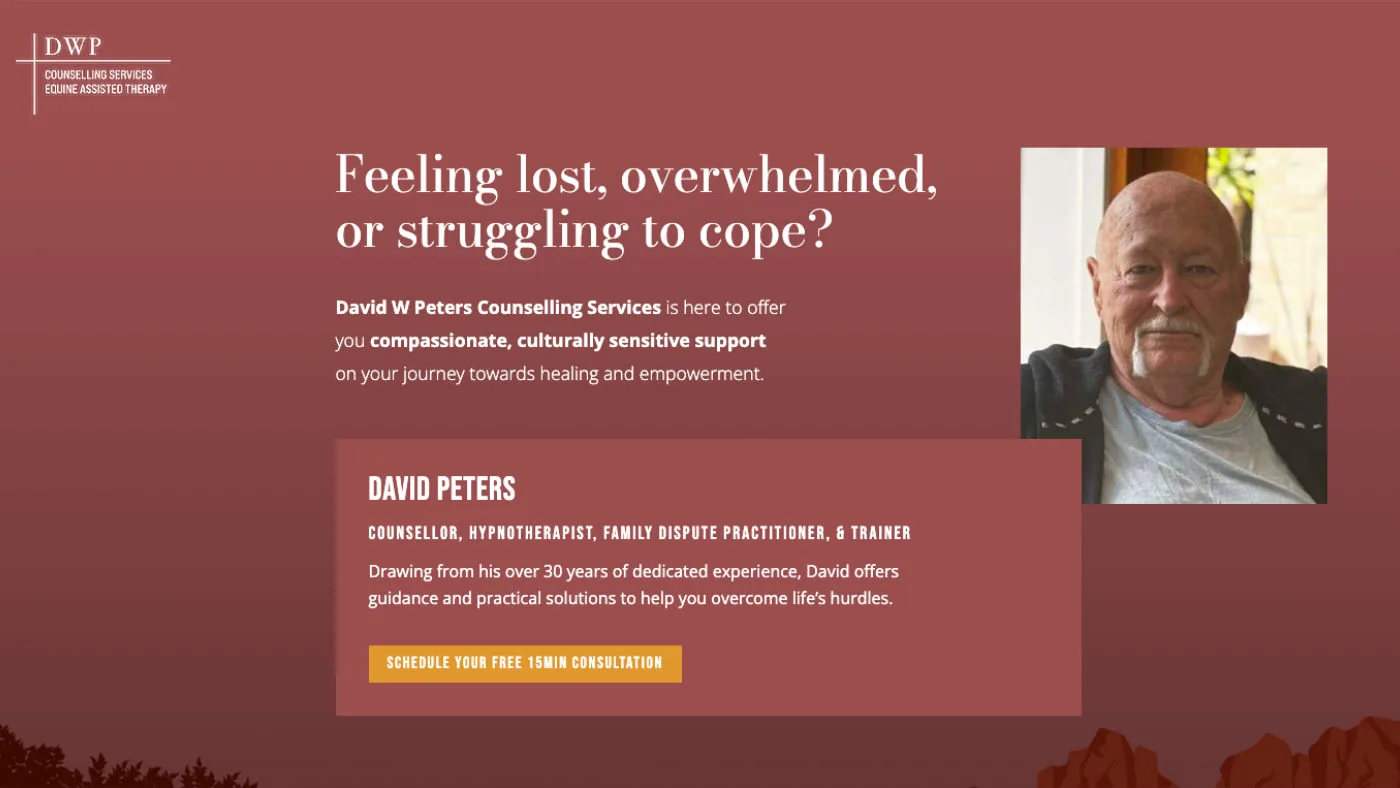
David W Peters needed a clear online starting point for a new counselling business. One focused page now supports booking requests alongside search, social media and referrals.
A new business does not always need a large website. It needs enough information for the right visitor to understand the service, assess its relevance and take the next step, wherever they first encountered the business.
The starting point
David W Peters was starting a counselling business and needed an online presence. He came to Clip Magic through a referral.
The immediate task was focused. A visitor needed to understand who David is, whom he counsels, the qualifications and experience behind his work, and how to contact him to arrange a session.
Why a landing page suited the business
A multi-page website would have created more places to publish content without automatically making the business easier to understand. At launch, a single well-structured page could answer the essential questions.
The page begins with the visitor's situation, then names David and his professional roles. It explains his experience, areas of support and approach before presenting a clear way to schedule an initial consultation.
The information hierarchy
The order matters. Visitors first need to recognise whether the service may be relevant to them. They can then assess the person offering it and decide whether to make contact.
- The opening addresses people who feel lost, overwhelmed or unable to cope.
- David is identified as a counsellor, hypnotherapist, family dispute practitioner and trainer.
- His experience and culturally informed approach are made visible.
- Professional memberships and credentials support the written introduction.
- A consultation link gives visitors a clear next step.
A small website can still be complete
Complete does not mean exhaustive. It means the website supplies enough relevant information for its present purpose.
David's landing page establishes identity, audience, credibility and contact in one place. Additional pages can be added later if the business develops a genuine need for them. Starting small avoids padding a new website with generic material simply to make it look larger.
What happened after launch
David has since received online booking requests, and Google Search Console has recorded consistent clicks to the website. These are useful signs that people are finding the page and using its booking path.
They do not show that the website alone generated each enquiry. David also regularly promotes his services through social media posts in relevant local groups, and referrals remain part of the wider picture. For privacy reasons, individual bookings cannot be matched publicly to search activity or particular posts.
The useful conclusion is that the one-page website supports a multi-channel approach. Someone may first hear about David through a local group or referral, then use the website to understand his background and book. The page does not need to be the only source of discovery to do its job.
The practical lesson
Choose the size of a website according to the job it needs to perform. A clear one-page site can be more useful than several vague pages, especially when it gives people from search, social media and referrals one reliable place to assess the service.
The measure is not page count or a claim that one channel caused every enquiry. It is whether the intended visitor can understand the service, trust the person behind it and act without unnecessary confusion.
Related Insight: Can a stranger, Google or AI understand your business?